

Cordyceps: Natural vs. Cultivated – What’s the Difference?
By Dr.Trung
14/07/2025
Cordyceps is one of the most precious medicinal herbs in traditional medicine, often referred to as “soft gold” for its ability to restore health and prevent various chronic diseases. However, the market currently offers two popular product lines: cultivated Cordyceps and natural Cordyceps.
So, what’s the difference between cultivated and natural Cordyceps? Is the cultivated product inferior to its natural counterpart? Let’s explore the details with Dr. Trung to help you make an informed and confident choice.
Contents
1. Differences in Habitat and Formation
Natural Cordyceps is a parasitic fungus that grows on the larvae of certain moth species, thriving in high-altitude mountainous regions like Tibet, Qinghai, and Sichuan, at elevations ranging from 3,000 to 5,000 meters. The harsh climate and unique biological environment cause this fungus to develop slowly, taking 3 to 5 years to accumulate sufficient medicinal properties.
Conversely, cultivated Cordyceps is grown in laboratories under strictly controlled conditions of temperature, humidity, and light. Its development time is much faster, requiring only about 60 to 90 days for harvesting. Cultivated varieties typically use substrates such as brown rice, potatoes, or mung beans, along with essential vitamins and minerals.
2. External Appearance and Color
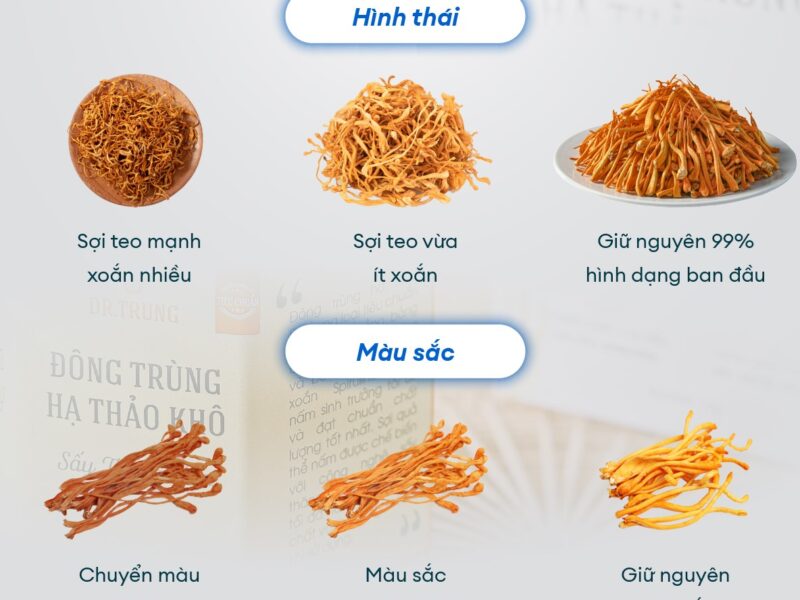
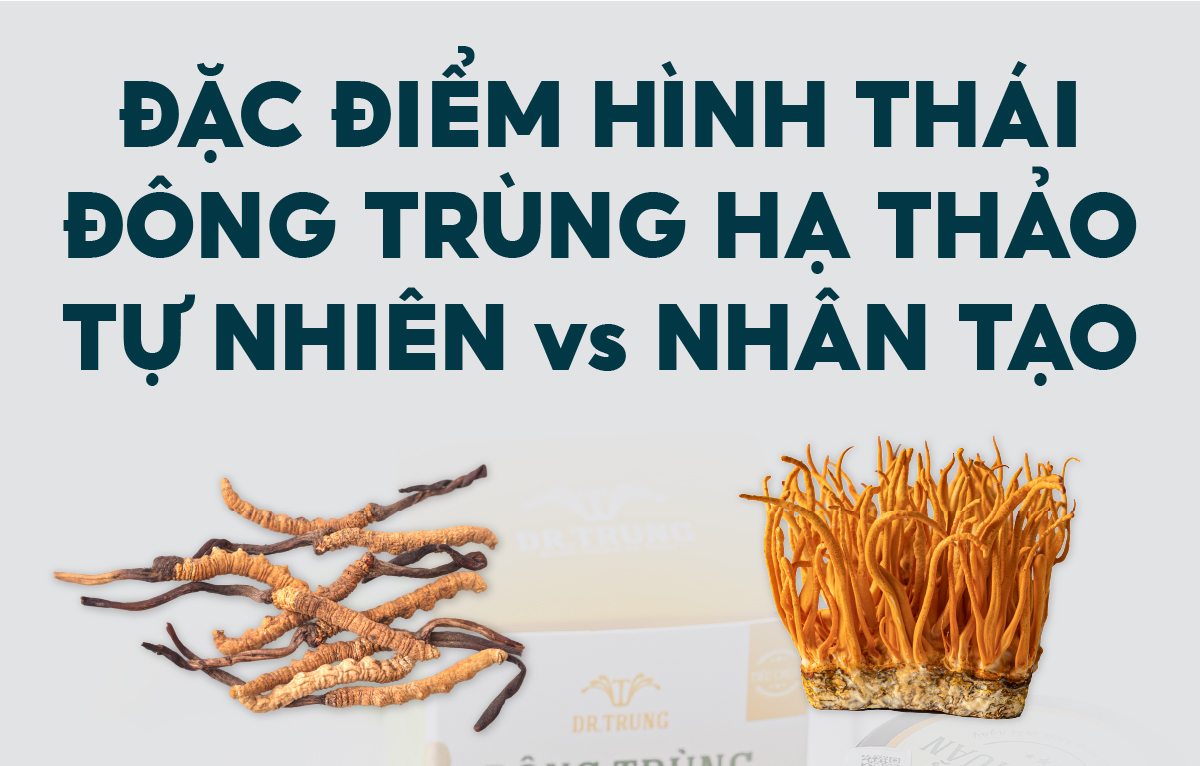
When viewed with the naked eye, natural Cordyceps has a distinctive yellowish-brown or dark brown color, a slender, slightly dry body, and fungal threads growing from the insect larva. Due to its natural growth in the wild, each individual specimen has an irregular shape.
In contrast, cultivated Cordyceps typically has a vibrant orange-yellow color, with mushroom strands growing uniformly, appearing larger and longer. The cultivated product’s appearance is often more appealing due to meticulous care and standardization under modern cultivation conditions.
3. Differences in Nutritional Content
Both types contain valuable active compounds such as Cordycepin, Adenosine, Polysaccharides, along with over 17 types of amino acids, vitamins, and minerals. These components are capable of boosting immunity, supporting cancer treatment, improving physiological function, restoring liver and kidney function, and protecting cardiovascular health.
However, due to harsh natural growth conditions, the active compound content in natural Cordyceps is generally higher. If rated on a scale of 10, natural Cordyceps might score around 10 points, while cultivated varieties would score 5 to 6 points.
Nonetheless, this difference is not significant when used for daily health supplementation. At a reasonable price point, cultivated products still offer good efficacy for users if produced according to proper procedures and standards.
4. Large Price Discrepancy – Why?
Natural Cordyceps is extremely rare, with annual yields accounting for only a very small fraction of the market. Harvesting is primarily manual, dependent on weather and terrain conditions, leading to prices that can reach billions of Vietnamese dong per kilogram of dried product.
Meanwhile, cultivated Cordyceps is produced using high-tech agricultural models, allowing for year-round cultivation. This significantly reduces the product’s cost to just tens to hundreds of millions of Vietnamese dong per kilogram, depending on quality and the producer.
5. Which Type is More Suitable for Users?
If you require intensive disease treatment support, have sufficient financial resources, and can access a verifiable source of products, natural Cordyceps may be more suitable. However, counterfeiting of natural Cordyceps is very common, and not everyone has enough experience to distinguish genuine from fake products.
For the average consumer seeking long-term health benefits, cultivated Cordyceps from a reputable brand remains a smart, economical, and effective choice. The most important thing is to choose a trustworthy supplier with transparent testing, clear documentation, and consumer confidence.
6. Dr. Trung – A High-Quality Cultivated Cordyceps Producer in Vietnam
In Da Nang, Dr. Trung is one of the pioneers in the field of cultivating, producing, and distributing medicinal standard cultivated Cordyceps. With over 4 years of experience, Dr. Trung currently operates a closed-loop production model from mushroom strain cultivation, harvesting, to packaging and distribution.
Dr. Trung’s Cordyceps products have achieved 4-star OCOP certification and have been featured at major events such as the Asia Routes forum, national, and regional product trade fairs. The brand has over 40 distributors nationwide, along with a strong sales presence on e-commerce platforms like Shopee, Lazada, etc.
Customers choose Dr. Trung because of:
-
Products meeting safety standards with clear origins.
-
High effectiveness in nourishing and boosting immunity.
-
Attractive designs, suitable as health gift sets.
Contact Dr. Trung now for consultation on suitable Cordyceps products and to receive the best offers!